In this guide
- What the exam is
- The legal basis
- Who takes it, who is exempt
- How the exam day works
- How it is marked
- The Greek-language parts
- What the knowledge questions cover
- The question formats
- Why it is harder than it looks
- Dates, fee and applications
- How to prepare
- Our recommendation
- After the exam
- Questions and answers
- Sources
What the exam is
The Greek citizenship test is a state examination that foreign nationals have to pass before they can be naturalised as Greek citizens. Its official name is Πιστοποιητικό Επάρκειας Γνώσεων για Πολιτογράφηση, the Certificate of Adequate Knowledge for Naturalisation, and everyone calls it by its initials, Π.Ε.Γ.Π. Passing gives you the certificate; the certificate is one of the documents you need for the naturalisation application itself.
It is not only a civics quiz. The exam has three parts on the same day: a written paper with 20 knowledge questions and a Greek reading-and-writing section, a listening test, and a short oral exam. The language parts are set at a level corresponding to B1. The knowledge questions are drawn from a public bank of 300, in four areas: geography, history, culture and the institutions of the political system.
The exam has been required since 2021. It is run by the Ministry of the Interior (Υπουργείο Εσωτερικών) twice a year, in state schools across Greece. In recent years about 8,000 people have sat it per year, most of them Albanian nationals, and roughly half have passed.
The legal basis
The requirement comes from Law 4735/2020, which amended the Greek Citizenship Code and made the certificate a condition for the naturalisation of foreign nationals of non-Greek descent (αλλογενείς). The first sittings took place in 2021.
How the exam is organised — its parts, the marking, the pass marks, the fee and the arrangements for special categories — is set out in a ministerial decision. The one in force is decision 21536 of 22 April 2026 of the Ministry of the Interior, published in the Government Gazette (ΦΕΚ Β′ 2319 of 24 April 2026). It replaced the earlier decisions from 2021 onwards.
The same ministry publishes the question bank (Τράπεζα Θεμάτων) on the exam platform, exetaseis-ithageneia.ypes.gr. The knowledge questions come with their correct answers, and the bank is renewed every year, by about 10 % for the knowledge part. The edition in force at the time of writing is the November 2026 edition.
Who has to take it, and who is exempt
The exam applies to foreign nationals who apply for Greek citizenship by naturalisation and who are not of Greek descent. In practice this is the large majority of applicants: people who have lived in Greece for years on a residence permit, EU citizens, refugees, and their adult children if they did not go through Greek schools.
You do not have to take the exam if:
- you are of Greek descent (ομογενής), or
- you completed at least nine years of schooling in Greece and hold a Greek state-school leaving certificate, or
- you hold a degree from a Greek university.
Two groups sit a different version of the exam rather than being exempt. Candidates aged 62 or over (by calendar year) and people with a certified learning difficulty answer the knowledge questions orally, in front of a committee, and do the written-language paper only; there is no listening or speaking test for them. People with a certified disability of 67 % or more take a shorter oral exam on a reduced syllabus.
The exam is only one condition for naturalisation. The application itself normally requires seven years of continuous legal residence in Greece (three for some categories, such as the spouses of Greek citizens with a child, or recognised refugees), a lawful income, a clean criminal record and other documents. The rules depend on your situation: check them on the Ministry of the Interior website or with the citizenship directorate of your region. This guide is not legal advice.
How the exam day works
- You apply online and pay the feeon the exam platform, with your taxisnet codes, during the application window before each sitting. The fee is 150 €. You choose a city; the Ministry sets up exam centres in state schools and tells you where to go.
- The written paper: 150 minutesin one booklet. First the 20 knowledge questions — 4 on geography, 6 on history, 4 on culture and 6 on the institutions of the political system, 2 points each. Then the Greek reading-and-writing section: a text with comprehension questions, grammar and vocabulary exercises, and a short composition.
- A 15-minute break, then the listening testtwo recorded passages, each played twice, with 10 questions in all.
- The oral examon your own, in front of two assessors, for up to 15 minutes: questions about yourself and your life in Greece, then a task based on a picture you draw from a set of four.
- Marking and resultsevery script is marked by two examiners, with a third if they disagree widely. Results are published on the platform under your application. There is no appeal and you cannot see your marked script. If you pass, the certificate is issued and you can use it for your naturalisation application.
How it is marked
The exam is marked out of 100, split like this:
- Knowledge questionsΘεματικές Ενότητες — 20 questions × 2 points40
- Reading and writingΚατανόηση και Παραγωγή Γραπτού Λόγου30
- ListeningΚατανόηση Προφορικού Λόγου — 10 items × 1.5 points15
- SpeakingΠαραγωγή Προφορικού Λόγου15
To pass you need 70 points out of 100, and at the same time at least 20 out of 40 on the knowledge questions and at least 40 out of 60 on the three language parts together. All three conditions apply: a perfect score on the knowledge questions cannot make up for weak Greek, and fluent Greek cannot make up for not knowing the material.
In practice, since 40 out of 60 and 20 out of 40 add up to only 60, most candidates who pass do so by scoring well above the minimum on at least one side. A comfortable target is 30 or more on the knowledge questions, which is 15 of the 20 right.
The Greek-language parts
Three of the four parts of the exam test your Greek, and they carry 60 of the 100 points. The level is described in the decision as corresponding to B1 of the Common European Framework: you can follow everyday texts and conversations, write a short connected text and talk about yourself and familiar topics.
- Reading and writing (30 points): a text followed by nine comprehension questions and nine grammar-and-vocabulary exercises, one point each, and a short composition worth 12 points.
- Listening (15 points): two passages, each played twice with a pause in between, and ten questions worth 1.5 points each.
- Speaking (15 points): a conversation about yourself followed by a task based on a picture.
The language material is also drawn from the official bank: 100 written topics, 50 listening topics with their audio files, and 25 speaking topics. The course we recommend below covers the knowledge questions; it does not currently teach the language parts.
What the knowledge questions cover
The knowledge part of the exam (Θεματικές Ενότητες) is drawn from a bank of 300 questions in four official sections. Your paper takes a fixed number from each:
- GeographyΓεωγραφία70 in the bank · 4 on your paper
- HistoryΙστορία80 in the bank · 6 on your paper
- CultureΠολιτισμός70 in the bank · 4 on your paper
- Institutions of the political systemΘεσμοί του Πολιτεύματος80 in the bank · 6 on your paper
Geography includes regions and regional units, mountains, rivers and lakes, islands and seas, climate and the economy. History runs from antiquity through Byzantium, the Ottoman period, 1821, the modern state, the world wars and the dictatorship to the Third Hellenic Republic. Culture covers mythology, religion and festivals, customs, literature, art, music and sport. Institutions covers the Constitution, the President, Parliament and Government, the courts, local government, the European Union and international organisations.
See two real questions from each section, with translations and answers, on Greek citizenship test questions by topic.
The question formats
This is where the Greek exam differs most from citizenship tests elsewhere. Only about half of the 300 questions are multiple choice. The bank uses seven formats, and all of them can appear on your paper:
- Multiple choice (Α, Β, Γ or Δ): one correct answer out of four. 152 of the 300 questions.
- True or false (Σωστό / Λάθος): four statements, and you write Σ or Λ for each. 52 questions.
- Fill in the blanks: a short text with numbered gaps and a list of words to choose from; sometimes one word is left over. 31 questions.
- Matching: pair the items in column I with those in column II. 25 questions.
- Sorting: put the given items into two groups, for example rivers and lakes, or mainland and island Greece. 4 questions.
- Open questions: “name four …”, with no options at all. You write the names yourself, in Greek. 16 questions, nearly all in geography.
- Maps and photographs: 20 geography questions ask you to mark four places on a blank map of Greece in your booklet, and 24 history and culture questions show a photograph of a person, monument or artwork and ask what or who it is.
Why it is harder than it looks
Twenty questions from a public list with the answers attached, and only ten of them needed: on paper the knowledge part sounds easy. Roughly half of all candidates nevertheless fail the exam. Five things make it harder than it looks.
Everything is in Greek
There is no English, Albanian, Russian or Ukrainian version of the paper. The questions use formal, written Greek, with names of places, people and institutions you may never have heard in everyday conversation. Even the instructions are in Greek.
You write, you do not tick
There is no answer sheet with boxes. For every question you write the question number and your answer in a booklet (τετράδιο): a letter for multiple choice, Σ or Λ for each statement, the missing words, the pairs, the names, or dots and names on a map. Spelling and handwriting in Greek matter.
Three hundred questions in seven formats
Memorising 300 multiple-choice answers is one thing. Knowing fifteen inland regional units, which lakes are in Macedonia, where Kastoria is on a blank map, or which customs belong to which festival, is a different kind of knowledge, and the open and map questions do not give you anything to recognise.
The knowledge part is only 40 points
Sixty points are language. Many candidates know the material and still fail because the composition, the listening test or the interview pulls them below 40 out of 60. The two sides of the exam have to be prepared together.
Every attempt costs 150 euros and six months
The exam is held twice a year. If you fail in November, the next chance is in spring, and you pay the fee again. For most people the real cost of failing is the delay to their naturalisation.
Dates, fee and applications
The exam takes place twice a year, normally in spring and in autumn. In 2026 the sittings were on 26 April and 15 November. The next sitting will be in spring 2027; the Ministry announces the date and the application window on the platform a few weeks in advance. We do not print dates the Ministry has not published.
The fee is 150 € per sitting. It is waived the first time you sit if you already have a naturalisation application pending; if you fail and sit again, you pay. Applications are made online, with your taxisnet codes, at exetaseis-ithageneia.ypes.gr, and the window is open for at least four weeks. Exam centres are set up in the cities with enough candidates; Athens and Thessaloniki always have them, and about half of all candidates sit in Attica.
How to prepare
- Work from the official bank, in Greek. The questions on your paper will be these 300, in this wording. Use English to understand them, but learn to read the Greek, because that is what you will see.
- Practise every format, not just multiple choice. Write the open answers out, do the matching and sorting questions on paper, and place the map places on a blank map until you can do it from memory.
- Learn by section. Geography and institutions are lists and structures; history and culture are stories and dates. Different sections need different kinds of revision, and your paper takes 4, 6, 4 and 6 questions from them.
- Do timed runs. Twenty questions in the proportions of the real paper, written out as you would in the booklet, and aim for 15 or more correct rather than the minimum 10.
- Prepare the Greek-language parts separately. Read everyday texts, listen to Greek radio and news, practise writing short texts and talking about yourself. The knowledge part cannot carry you through on its own.
- Check that your material is the current edition. The bank changes by about 10 % a year. Material based on an older edition will contain questions that are no longer asked and miss new ones.
Our recommendation: the CivicLearn course
We work with CivicLearn, which sells and runs this course. We recommend it because it is built around the official bank and the real formats.
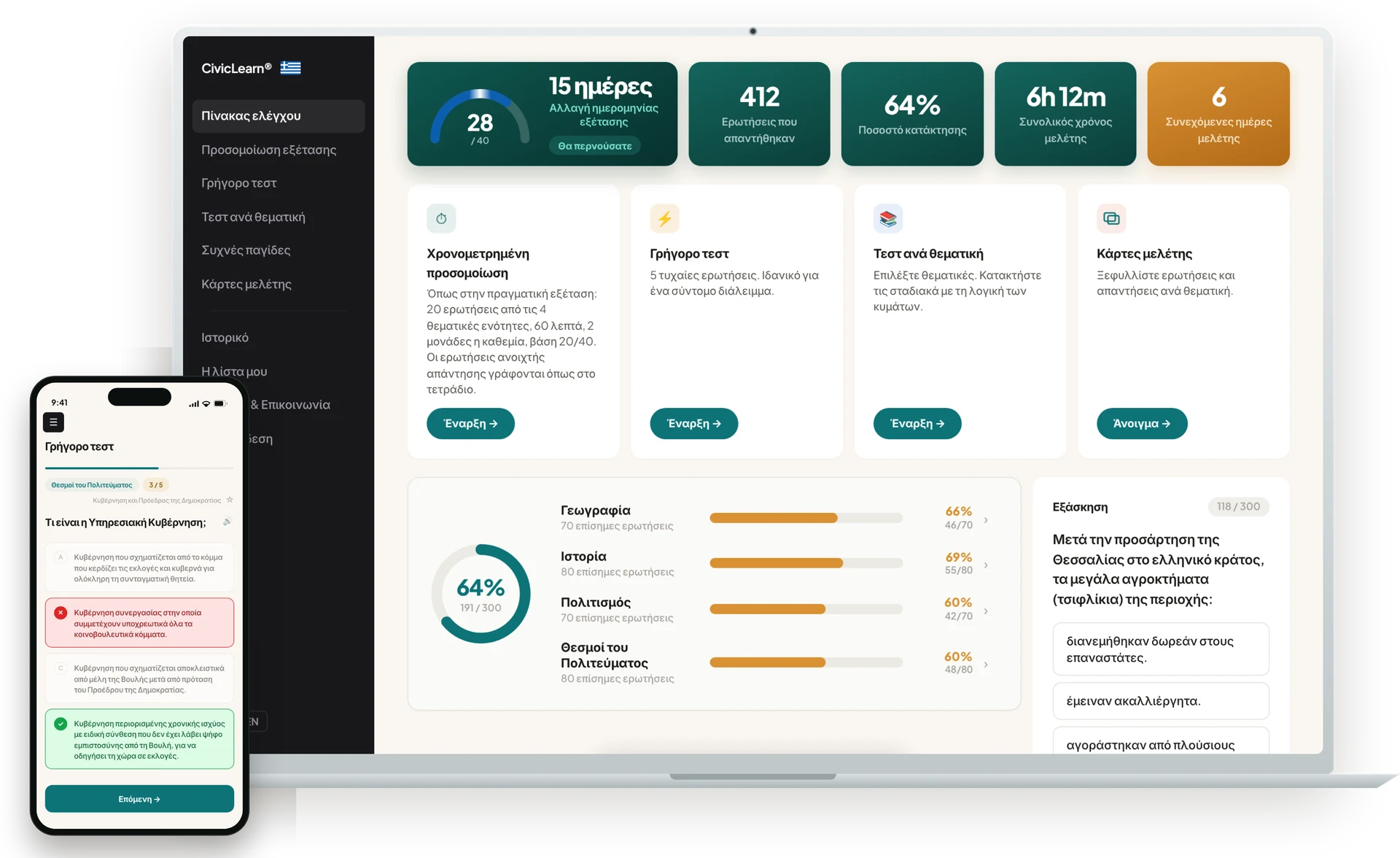
CivicLearn’s course for the knowledge part of the Π.Ε.Γ.Π. (Εξετάσεις Πολιτογράφησης) is in Greek, as the exam is, with an English hint on every question.
- All 300 official knowledge questions from the current edition of the bank, with the official answers.
- Every real format: multiple choice, true or false, fill in the blanks, matching, sorting, open “name four” questions, maps and photographs.
- An English hint on every question, one tap away behind the globe button, so you learn the Greek wording without getting lost. Albanian, Russian and Ukrainian hints are coming.
- A timed simulation like the real paper: 20 questions in the official proportions, 60 minutes, pass at 20 out of 40.
- Study by section, flashcards, a list of saved questions and your progress for each of the four sections, saved to your account.
- Works on phone, tablet and computer.
Secure card payment via Stripe; access immediately after payment. The course covers the knowledge part of the exam; it does not currently teach the Greek-language parts. Already a customer? Log in.
After the exam
Results are published on the exam platform. If you pass, the Ministry issues your certificate, and you attach it to your application for naturalisation at the citizenship directorate (Διεύθυνση Ιθαγένειας) for your region. The certificate does not itself make you a citizen: the naturalisation application has its own conditions — years of legal residence, income, criminal record and others — and its own interview and decision. For those, see the Ministry of the Interior or ask a lawyer; this guide stops at the exam.
If you fail, you can register again for the next sitting. Your result is given by part, so you can see whether it was the knowledge questions or the language that let you down, and prepare accordingly.
Questions and answers
Is the Greek naturalisation exam available in English?
No. The whole exam is in Greek: the knowledge questions, the reading and writing paper, the listening test and the interview. English is useful for understanding and learning the material, but on the day you will only see Greek.
How many questions are there, and what do I need to pass?
Your written paper has 20 knowledge questions, worth 2 points each (40 points), plus a Greek reading and writing section (30 points). The listening test is worth 15 points and the speaking test 15. You pass with 70 out of 100 overall, with at least 20 out of 40 on the knowledge questions and at least 40 out of 60 on the three language parts.
Where do the questions come from?
From an official question bank published by the Ministry of the Interior: 300 knowledge questions, 70 on geography, 80 on history, 70 on culture and 80 on the institutions of the political system. The bank is public and includes the answers. About 10 % of it is renewed each year.
When is the exam held, and how do I apply?
Twice a year, in spring and autumn. In 2026 the sittings were on 26 April and 15 November; the next one is in spring 2027, on a date the Ministry has not yet announced. You apply online through taxisnet on exetaseis-ithageneia.ypes.gr during the application window, which is open for at least four weeks before each sitting.
How much does the exam cost?
150 €, paid when you apply. The fee is waived the first time you sit if you already have a naturalisation application pending. If you fail and sit again, you pay again.
Who does not have to take it?
People of Greek descent (ομογενείς), people who finished at least nine years of schooling in Greece and hold a Greek state-school leaving certificate, and graduates of Greek universities. Candidates over 62 and people with a certified learning difficulty do sit it, but take the knowledge part orally and skip the listening and speaking tests.
What level of Greek do I need?
The language parts are set at a level corresponding to B1 of the Common European Framework: everyday texts, a short composition, two listening passages played twice, and a conversation about yourself and a picture.
What happens if I fail?
You can sit again at the next sitting, and many people do: roughly half of all candidates fail each time. You pay the 150 € fee again. There is no appeal and you cannot see your marked script.
Is this an official website?
No. This is an independent guide. It is run by Testrada Pte Ltd, which works with CivicLearn, the company that sells the course we recommend. For official information, see the Ministry of the Interior and the exam platform exetaseis-ithageneia.ypes.gr.
Does the CivicLearn course cover the Greek-language parts?
Not at the moment. The course covers the knowledge part: all 300 official questions in every official format, with an English hint on each. Material for the language parts may come later; the course does not sell it now.
How much does the CivicLearn course cost?
49 € once, with unlimited access. There is no subscription and no automatic renewal. Payment is by card through Stripe, and access starts immediately.
Sources
- Ministry of the Interior, decision 21536/22-4-2026 (ΦΕΚ Β′ 2319/24-4-2026): organisation, content, marking and fee of the examination for the Πιστοποιητικό Επάρκειας Γνώσεων για Πολιτογράφηση.
- Law 4735/2020, which introduced the certificate as a condition for naturalisation in the Greek Citizenship Code.
- The official exam platform, exetaseis-ithageneia.ypes.gr: applications, the question bank (Τράπεζα Θεμάτων, November 2026 edition) and results.
- Ministry of the Interior statistics on the sittings of 2024–2026 (participants and pass rates), published June 2026.
This guide is for orientation and is not legal advice. Last reviewed 2 November 2026.